
Platelet Biology & Morphological Stages
For a long time, modern medicine viewed platelets simply as the body’s natural bandages—cells whose only job was to clump together and stop bleeding. Today, the science of regenerative medicine has proven they are sophisticated, microscopic delivery vehicles packed with the healing proteins required to repair damaged tissue.
However, there is one critical biological fact to understand: a platelet does not have a nucleus. Because it lacks a central “brain” or DNA to adapt to its environment, a platelet is completely reactive. It relies entirely on outside physical and chemical signals to tell it what to do. When it receives the right signal, it transforms its physical shape from a quiet, circulating disc into a fully activated regenerative engine. This page explores that physical transformation, which is the critical first step in mastering Platelet-Rich Plasma (PRP) therapy.
Understanding the precise mechanisms of Platelet-Rich Plasma (PRP) therapy is fundamental to optimizing patient outcomes. The efficacy of PRP relies on the dramatic morphological changes platelets undergo within the extracellular matrix.
Stage 1: Resting Platelet (Circulation & Surveillance)
Stage 2: Early Activation (Adhesion & Chemotaxis)
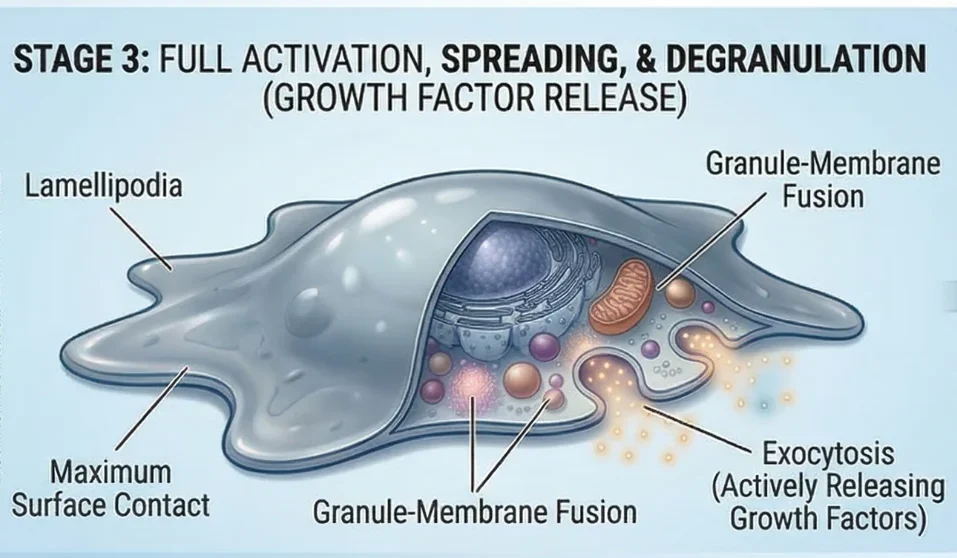
Stage 3: Full Activation (Spreading & Degranulation)
Stage 4: Aggregation (Hemostasis & Scaffold Construction)
Resting Platelet: A smooth, grey-blue, biconcave (lens-shaped) discoid platelet, optimal for streamlined flow in the circulation. Internally, this inactive cell is densely packed with its pre-formed arsenal. Distinct, labeled organelles include:
Mitochondria: Providing the metabolic energy (ATP) required to maintain this complex inactive state and power the future activation sequence.
Alpha-Granules: The primary storage sites, containing critical growth factors (e.g., PDGF, TGF-β, VEGF) and clotting proteins.
Dense Granules: Smaller granules storing signaling molecules (e.g., ADP, ATP, serotonin, calcium) essential for amplifying the activation response.
Open Canalicular System (OCS): A convoluted network of invaginated membranes providing a direct pathway from the cell’s interior to its surface for eventual payload delivery.

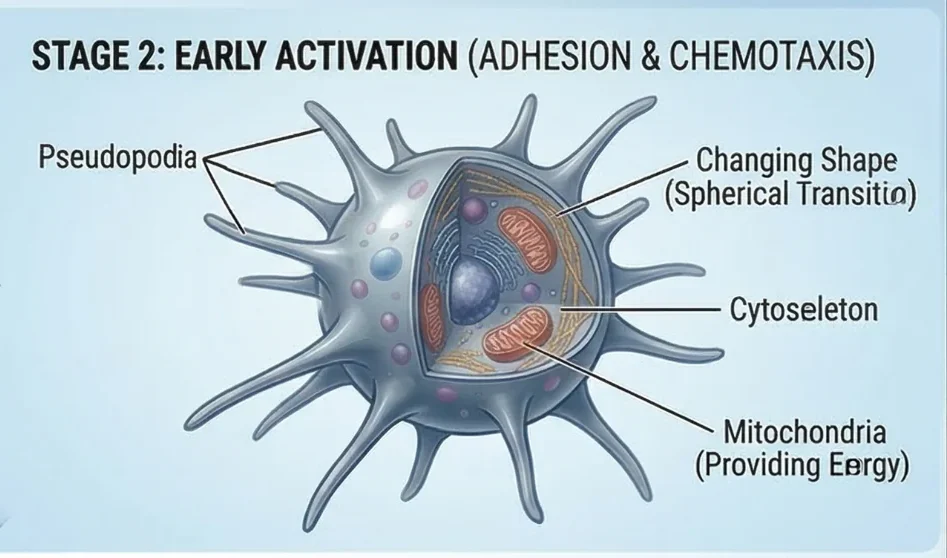
Early Activation: Triggered by agonists, the platelet rapidly transforms into a sphere and sprouts multiple long, slender, finger-like projections called Pseudopodia. Internal reorganization is powered by energy from the Mitochondria, which are visibly mobilized toward the newly forming pseudopodia. Granules and organelles are also mobilized closer to the membrane and developing extensions. This dynamic shape change dramatically increases the platelet’s surface area, making it highly effective at ‘snagging’ on to damaged tissue or initial fibrin strands.
Full Activation: The platelet completely flattens out, expanding its surface contact into widespread, broad sheet-like Lamellipodia (resembling a “fried egg”). Internally, this dramatic change triggers active degranulation: alpha and dense granules aggressively fuse with the OCS and the cell membrane, actively releasing their concentrated healing payload (represented by the glowing dots) into the extracellular space to initiate the complex healing cascade. Continued Mitochondria activity powers this high-energy secretory process. The diagram dramatically visualizes the pay-off of activation: the controlled, explosive release of potent regenerative signals.

Aggregation: Triggered by agonists, the platelet rapidly transforms into a sphere and sprouts multiple long, slender, finger-like projections called Pseudopodia. Internal reorganization is powered by energy from the Mitochondria, which are visibly mobilized toward the newly forming pseudopodia. Granules and organelles are also mobilized closer to the membrane and developing extensions. This dynamic shape change dramatically increases the platelet’s surface area, making it highly effective at ‘snagging’ on to damaged tissue or initial fibrin strands.
Technical Note: The Biological Cost of Commitment
While the four-stage morphological model provides a clear functional framework for clinical discussion, it is important to recognize that platelet activation is not a simple “on/off” switch. In the laboratory and the surgical suite, we are managing a complex biological continuum of commitment.
The Resting State (Stage 1) as the Metabolic “Gold Standard”: The resting platelet is the only state where the cell is at its maximum potential. In this phase, the platelet maintains a high reservoir of ATP and sequestered Ca2+ levels. Once a platelet is triggered (whether by the intended target tissue or accidentally by mechanical vibration) it enters a state of metabolic exhaustion. A platelet that has “fired” its payload in a centrifuge is biologically incapable of the same level of sustained regenerative signaling once it reaches the patient.
The “Brainless” Responder: Because a platelet lacks a nucleus, it cannot “decide” to ignore a signal. It is purely reactive. Without DNA to guide adaptation, the platelet is entirely at the mercy of its immediate environment. It cannot distinguish between the “false signal” of a rattling centrifuge and the “true signal” of a surgical wound or ECM.
Receptor Sensitivity & Shedding: As a platelet transitions away from the resting state, it begins to “shed” critical surface receptors. This process effectively “blinds” the cell. If a platelet is prematurely activated, it may arrive at the wound site without the “ears” necessary to hear the body’s natural chemical instructions for tissue repair.
Clinical Summary: The resting phenotype is not merely a starting point; it is the protected, high-energy state required for a potent clinical dose. Protecting the platelet’s resting state from mechanical and chemical stress is one of the most important factors in the success of an autologous PRP procedure.
Next: The Activation Cascade & Payload Delivery
To understand how these “brainless” cells use a sophisticated lock-and-key system to deliver their growth factors exactly where they are needed and why outside chemicals can compromise this process
Proceed to our deep dive on [The Activation Cascade].